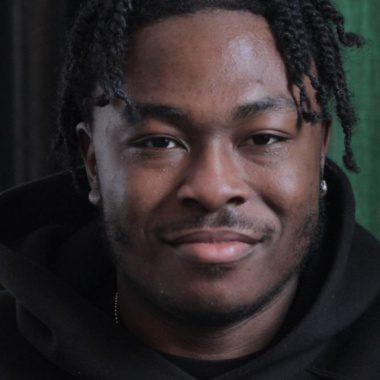

Mediorite Team
Ibby did a media apprenticeship with video production company Mediorite and is now a Junior Editor flexing his creative muscles with Adobe Suite, social channels and using AI to resolve issues like film quality and formatting. He is progressing his skills by leaning into directing, and could see himself running his own creative company one day. Check out his career tips and personal journey.
Meet Ibby…
Ibby Onitolo never got work experience after school. He tried working in retail and various apprenticeships like joinery. When he discovered a media apprenticeship with Mediorite, he was empowered to learn new skills that personally interested him and follow his passions to the benefit of both the video production company and himself.
What education / training got you into a Junior Editor role?
I studied Level 3 Creative Media Production and Technology in College and got a Pass grade (equivalent of a C).
I also went to a course on work skills (although I can’t remember the name of the qualification).
I got no work experience after education at all.
What was your career route into this job?
I worked in retail for a year after finishing college, applying for different apprenticeships including a carpentry and joinery apprenticeship as I thought for a while that it was what would pay well. I also applied for the ITV apprenticeship that comes around once a year as my sister had previously completed it and I thought it might be a good next step.
I found Mediorite through searching online for apprenticeships. I would regularly check Big Creative Education‘s website and apply for any creative courses and apprenticeships that suited me. I applied to Mediorite’s Junior Content Producer role.
I grew up around two very different sets of people, which has helped me understand how to communicate with people in extremely different environments, from corporate meeting rooms to estates in east London.
What was your job interview like?
I had a job interview that was a little like good cop, bad cop. I remember Lucy was very honest and real about the situation of work, that I’d be doing a range of things, would struggle quite a bit as it was super fast-paced and that balancing apprenticeship studies with work would be a challenge. I remember Matthew (Mediorite’s Head of Studio – see Matthew’s career journey) being more lighthearted about it, mentioning how some of the other team members were also apprentices and that he was once one himself so there was a support network.
Some tips for interviews would be that one; your interviewers are people, so being able to connect with your interviewers on a personal level will help keep you memorable. An example would be if your interview is in a cafe and you see they buy an oat milk latte like you do, mention it – people love connecting over the little things.
Another interview tip would be to research the company, and if certain values align with you, mention those within your answers.
Last tip I’d say, come with your own work. I remember sitting in my room for 3 days straight just taking clips from films I liked, finding music and creating edits on CapCut to put on my portfolio as I had no type of previous work.
What does your typical day as a Junior Film / Video Editor look like?
A typical day in my job involves communicating with my team, editing, scripting and filming social media content, and audience/platform analysis on Instagram/TikTok.
What technical skills or knowledge are useful in your job?
Technical knowledge includes knowing the Adobe Suite (Premiere Pro, After Effects, Photoshop and Illustrator).
It’s also useful to use AI to solve film-related problems such as poor audio quality, or different formats for video on different platforms, i.e what orientation should your video be on YouTube VS TikTok.
What life skills or personal strengths are useful in your job, and why?
Problem-solving is arguably the most important skill. If there’s anything wrong with the footage or audio, you have to find ways to fix it, always thinking outside the box.
Organisational skills are also important as an editor. You’re working on projects that other editors may pick up, or documents that other team members may want to add to, so keeping organised is very important.
Communication is also important. Knowing who you’re communicating with and how to communicate professionally with clients through emails and on calls is a very important thing.
Any challenges in the job?
One of the challenges I face as an editor is that you’re sitting in front of a computer screen almost all day, every day.
You may not always be editing content that interests you.
I also find balancing responsibilities challenging. I’ve started trying to manage social media, on top of editing client films and working with Mediorite’s SHIFT training Alumni to create our own film series.
My biggest challenge so far in my career has been progression. In other industries progression is a linear route; you go to uni to become a lawyer, do your master’s, join a firm, and then work your way up the ladder through hard work and promotions. Film isn’t like that at all, and I don’t know what the next step is. If you start off as a Junior Editor, you might end up doing some runner work, then assistant camera operator work, then Director of Photography (DoP) work. No-one’s progression is the same which makes it hard to know next steps.
What are the perks / highlights of being a Junior Editor?
The highlight of my job is that I can learn almost anything I want (as long as it’s film-related or can benefit the company).
I pitched taking social media more seriously as a company because that was one of the areas I would love to develop.
I pitched our film series to get a feel for being a director and the preparation involved.
Has your background had any impact on your creative career?
My upbringing has helped me in my creative career in a number of ways. I grew up around two very different sets of people, which has helped me understand how to communicate with people in extremely different environments, from corporate meeting rooms to estates in east London.
Another big impact is that my older sister went to university, something that my parents had advocated for. however, she didn’t enjoy it much and came out of uni to complete an apprenticeship which she enjoyed a lot more. When it came time for me to apply for university, seeing my sister’s experience made me sceptical on the benefits of applying. my parents, also seeing my sister’s experience, were a lot less adamant on me going and showed me other opportunities such as apprenticeships.
In terms of education, I wouldn’t have pursued a creative career if it wasn’t for most of my friends during school studying music, photography and media. After GCSEs one of the reasons I went on to study media was that I’d only heard positive things from my friends in school after their media classes.
What would you like your creative career to look like a few years down the line?
I would want to own my own creative company – managing video marketing campaigns for brands and artists across social media channels.
You’ve been granted the ability to send a message to 16-year-old you. What do you say?
Speak to everyone, it’s sad to say, but the way film is right now, the people you know mean more to progression than your skills.
Fun facts and personal insights! Did anything surprise you about the media industry?
How many different job roles you can actually do. If you work on set, you’ll see crews of 30+ people all doing different roles at the same time, there’s almost something for everyone.
Any advice for young people interested in video editing or film and media careers?
Create your own content and see if you actually enjoy creating, and if you’re just doing it for the money, this isn’t the career path for you.
More from our blog
See the latest news, insights and opportunities from Mediorite's award-winning video production company in London and Leeds.


Get Started
Your story is unique. That’s why we tailor our video production services uniquely to every client. Take the first steps by talking to Lucy Ferguson (MBE) about your project.