
Mediorite Team
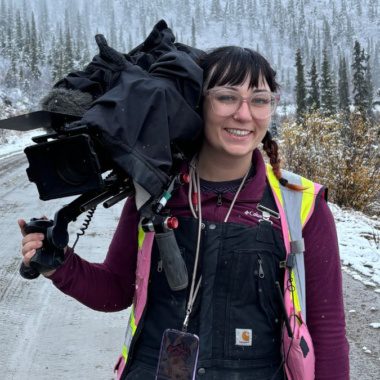
Leanne Rogers is a Freelance Shooting Assistant Producer. She’s also a Freelance Camera Operator for video production company Mediorite! Leanne chats through what’s involved in her work as a camera op, and how she got into this role.
Hi Leanne! What training and education led you to become a freelance camera operator?
Studying media at college…
I initially studied Media at college somewhat reluctantly, as I didn’t have the qualifications to pursue another subject I was interested in. My experience with Media at school had been uninspiring, so I wasn’t particularly enthusiastic. However, everything changed when I met my Media and Photography teachers at college. Their passion and engaging teaching styles transformed my perspective. I discovered a love for the technical aspects of Media and grew increasingly motivated.
Then a media production degree…
This led me to study Media Production at university, where I gained experience in a variety of areas, including multi-camera and single-camera production, scriptwriting, digital media, and design.
Volunteering with a media club…
During my weekends at university, I volunteered at an Arabic school, teaching young children practical media skills through a ‘Media Club.’
Volunteering led to paid work and promotion…
After graduating, I met Lucy, who was at the beginning of her journey with Mediorite. I started volunteering, doing vox pops around Hackney with other young people. That soon led to paid work delivering film training sessions. Eventually, someone took a chance on us to create films professionally, and I joined Mediorite as an employee.
Over the years, from 2015 to 2022, I worked my way up within the organisation, ultimately becoming Head of Creative. I then left after making two short documentaries (with Mediorite’s support), including the Violet Vixen documentary, to work in television.
Living the freelance life…
I now freelance for Mediorite as well as a variety of clients working for ITV, BBC, Channel 4, E4 and Discovery.
Check it out! In this video, Leanne describes what she was getting up to as Head of Creative with Mediorite. Those early filming shoots led to promotion and support to create her own documentaries. Find out more.
Did you get media work experience on your career journey?
I never managed to get work experience. A lot of my time was spent volunteering whilst I worked in zero hour contract jobs, so it gave me the flexibility to do that.
Got any media job interview tips?
I’ve had many job interviews since freelancing and they get easier the more you have done, as you get more confident.
The best thing is to be prepared, do your research and have some good questions to follow up with.
Describe your day as a freelance camera operator…
I always make sure I have enough protein snacks on me so I don’t get hungry. Shoots can run over and nobody wants to be hangry. So I’ll wake up, have a coffee or two and usually grab my snacks and protein shake and get to where I need to go with PLENTY of time.
I arrive, introduce myself and usually do a walk round and then start setting up my kit.
I usually show the client the framing to make sure they are happy and then get going.
If we are filming B roll, we usually have had pre-discussions but often think of things on the day that helps bring fun, spontaneity and more of the client and/or subject’s personality. We collaborate with each other.
Then at the end of the shoot, it’s time for packing down and DIT.
Know the lingo:
B-roll footage: B-roll is add-on footage that’s used to flesh out the main action in a video or film. Filmmakers can use b-roll footage to establish scenes and a sense of time and place, create smooth scene transitions, give context, boost storytelling, and add visual impact to immerse the viewer even more deeply in what they’re watching.
DIT: In the world of filming, this stands for Digital Imaging Technician. When they work on set, they help the DOP (Director of Photography) by doing technical stuff like making sure all digital footage is captured, stored, and backed up correctly. No-one wants to lose a day’s filming over technical issues! They can also do things like setting up and taking down cameras, quality control on any recorded material in terms of exposure etc., and preparing files for the video editor to work on in post-production.
What technical skills are useful for being a camera operator?
I personally think that when I learnt how to edit film I got better at shooting. It gives you a clear understanding of how the footage you capture will be used in the final product and how one shot can connect to another and what will and won’t work.
When you’ve got some experience in editing footage, you’re more likely to capture the necessary coverage, wide shots, close-ups, and cutaways because you know how vital those elements are in creating a seamless edit. You also develop an eye for framing, movement, and transitions that make an editor’s job easier and enhance the overall flow of the project.
Even if you don’t want to edit, I recommend at least sitting in and observing an edit.
Other useful technical skills for camera ops:
- manual focusing
- depth of field
- focus pulling techniques
- having good framing and composition.
And also having a good understanding of exposure management, so you might be using tools like histograms, zebras, and waveforms to ensure proper exposure in various lighting conditions.
Understanding basic lighting helps as well (I’m not amazing but I know my basics!)
What general life skills are useful in this job?
Life skills and personal strengths that are essential for camera operators include adaptability, communication, and attention to detail.
Adaptability
Adaptability is crucial because no two shoots are the same, and being able to think on your feet and troubleshoot unexpected challenges is part of the job.
Communication
Strong communication skills are important for collaborating with directors, crew, and talent to ensure everyone is on the same page and the vision is achieved.
Attention to detail
Attention to detail is key because the smallest adjustment in framing, lighting, or focus can dramatically affect the final shot.
Resilience
Patience and resilience also go a long way, as shoots can be physically and mentally demanding, often requiring long hours and quick problem-solving.
Any bits you find challenging in the job?
What I find challenging as a camera operator is when I’m tasked with making something visually appealing in a space with limited creative options like a small, unattractive room. It pushes my skills and creativity, but it can also be frustrating. Sometimes, this means having uncomfortable conversations with clients or colleagues to suggest adjustments or changes.
In my experience, though, those conversations often lead to better results and a stronger appreciation from the client, as they see you’re invested in delivering the best possible outcome.
Did you have any role models growing up?
Louis Theroux was my role model growing up, and he inspired me to make my first documentary short. He’s a brilliant role model because of his unique ability to approach complex and often uncomfortable subjects with empathy, curiosity, and a non-judgmental perspective. His style of storytelling is both engaging and thought-provoking, as he forms genuine connections with his subjects, encouraging them to open up and share their truths.
Have you had to overcome any challenges in your career?
One of my biggest career challenges was filming on a survival show. About a week into the shoot, I found myself lugging a camera up a mountain while trying to stay professional. Although I enjoy the outdoors, I hadn’t anticipated just how physically demanding the job would be. It took a toll on my body, and I had a moment where I broke down, even considering quitting.
But I pushed through, and after that day, things got easier. By the end of the shoot, I was awarded a golden boot for ‘longest standing worker on the ground,’ which was a huge confidence boost. That experience motivated me to join a CrossFit training center and start lifting weights, so I could be stronger and better prepared for the physical demands of the job. It also made me determined never to feel like I couldn’t keep up with others on set. Now, I actively seek out physically demanding roles—crazy, I know, but I love the challenge!
Have you ever had media career support from mentors?
I’ve had a couple of mentors, I currently have a great one who works at Channel 4 digital. I think it’s really beneficial to have that soundboard.
Freelancing can be quite lonely and scary. To have someone to talk to and help support you or even bring clarity to a confusing situation is always helpful.
Editor’s note: Leanne has actually been a mentor herself! As Head of Creative at Mediorite she was often mentoring SHIFT trainees and young people just starting out in their film career. It’s good when we get help and we help others 😉
How do you picture your creative career a few years down the line?
I’m already really proud of how far I have come, I guess I just want to be thriving in my career and be remembered for some of the work and stories I have told.
What would you say to your 16 year old self?
After school, I spent a year studying drama at college, I couldn’t dance nor sing and I definitely couldn’t act. All I knew was I wanted to do something creative. I would shout to my 16 year old self ‘Don’t do performing arts, go to college and study media!’
What surprised you most about the media industry?
Some of the most wonderfully weird and beautiful people I’ve met have been in the media industry. There’s a unique, quirky charm to the characters drawn to this world, and I always enjoy connecting with them and feeding off each other’s creative energy.
Any advice for young people thinking about becoming a camera operator?
I would say you don’t have to go to university like I did to start off now. Nowadays there are many training programmes, apprenticeships or runner roles than there once were, when I started. Hands-on experience, in my opinion, was where I learnt the most.
More from our blog
See the latest news, insights and opportunities from Mediorite's award-winning video production company in London and Leeds.


Get Started
Your story is unique. That’s why we tailor our video production services uniquely to every client. Take the first steps by talking to Lucy Ferguson (MBE) about your project.